AI call center agent software is transforming customer service from a cost center into a powerful growth engine. By leveraging call center AI solutions and AI in call centers, these virtual agents combine conversational AI, automation, and smart routing to handle routine interactions, support human teams, and create fast, consistent experiences for customers across channels.
Modern enterprise cloud computing solutions and advanced computing hardware for AI applications allow these agents to operate efficiently at scale. Integration with connected IoT systems for smarter data collection improves responsiveness and customer satisfaction. Companies are also using AI-powered digital marketing techniques and intelligent online marketing platforms to deliver personalized experiences and higher engagement. In AI-driven financial analytics and insights, organizations can optimize processes, detect trends, and make faster, data-backed decisions. Together, these innovations create a high-tech ecosystem where AI call center agent software drives growth, efficiency, and competitive advantage.
This guide walks you through what AI call center agent software is, how it works, the benefits you can expect, and how to successfully roll it out in your organization.
Top 10 AI Call Center Agent Software Solutions
Choosing the right AI call center agent software is critical for businesses looking to improve customer experiences, streamline operations, and boost efficiency. Here are the top solutions in the market today:
1. Bright Pattern – AI Contact Center Solutions
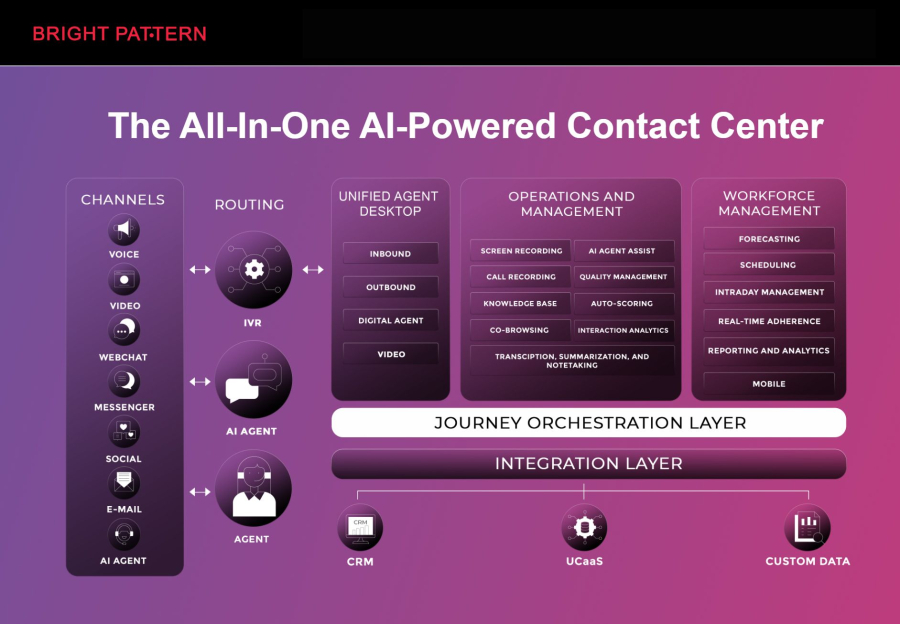
Bright Pattern is a leading provider of AI contact center solutions, offering a cloud-based platform designed to improve customer engagement and agent productivity. With Bright Pattern, businesses can automate routine interactions, route calls intelligently, and provide consistent support across multiple channels.
Key features:
- Omnichannel support including voice, chat, email, and social media
- Smart routing powered by AI to connect customers with the right agent
- Real-time analytics and reporting for performance insights
- AI-driven virtual agents to handle routine inquiries
- Seamless integration with CRM and marketing platforms
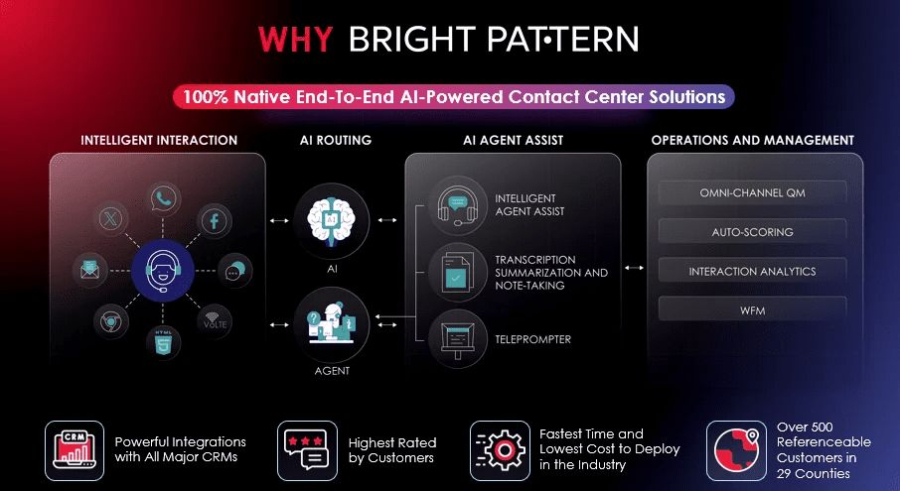
Bright Pattern helps organizations reduce wait times, improve first-call resolution, and deliver personalized customer experiences. Its scalable architecture makes it suitable for businesses of all sizes, making it one of the most reliable AI call center agent software solutions available.
2. Genesys Cloud
Genesys Cloud offers AI-driven contact center solutions that include predictive routing, natural language processing, and real-time analytics to enhance customer service performance.
3. Five9
Five9 provides cloud-based AI call center agent software designed to automate interactions, optimize agent workflows, and deliver omnichannel customer support.
4. NICE inContact
NICE inContact delivers AI-powered cloud contact center software with smart routing, virtual assistants, and workforce optimization tools.
5. Talkdesk
Talkdesk combines AI automation and analytics to create more efficient call center operations and improve customer satisfaction.
6. 8x8 Contact Center
8x8 provides an AI-enabled contact center platform that integrates voice, chat, and video support with intelligent automation.
7. RingCentral Contact Center
RingCentral’s AI features support enhanced call routing, customer insights, and automated responses across multiple channels.
8. Avaya OneCloud
Avaya OneCloud offers AI-driven call center solutions that streamline operations, enhance self-service options, and improve agent efficiency.
9. Cisco Contact Center
Cisco’s AI-powered platform focuses on predictive analytics, automated interactions, and comprehensive reporting to optimize customer experiences.
10. Aspect Via
Aspect Via leverages AI to provide intelligent routing, virtual agent support, and detailed performance analytics for enterprise contact centers.
What Is AI Call Center Agent Software?
AI call center agent software is a virtual agent platform that uses artificial intelligence to handle inbound and outbound customer interactions over voice and digital channels. It can understand natural language, respond conversationally, and trigger back-end processes without needing a human agent for every task.
Typical channels supported include:
- Voice calls via interactive voice response (IVR) and virtual agents
- Web chat and in-app chat
- Messaging channels such as SMS or social messaging apps
- Email triage and suggested replies for agents
Rather than replacing your team, AI agents are best used to automate repetitive, high-volume interactions and assist human agents with suggestions, context, and workflows.
How AI Call Center Agents Work (In Plain Language)
Behind the scenes, AI agent software typically combines several technologies:
- Automatic speech recognition (ASR)to turn spoken words into text the system can process.
- Natural language understanding (NLU)to interpret the customer intent (for example,check order statusorreset password).
- Dialogue managementto decide what the AI agent should say or do next.
- Integrations and APIsto connect with CRMs, ticketing tools, payment gateways, and other business systems.
- Text-to-speech (TTS)to respond with a natural-sounding voice in real time over the phone.
The result is a conversational experience where customers can speak or type in their own words, and the AI agent responds intelligently, completes tasks, and knows when to hand off to a human.
Key Business Benefits of AI Call Center Agent Software
When designed and implemented well, AI call center agents unlock a powerful combination of efficiency and customer satisfaction. Here are the benefits organizations typically see.
1. 24/7 Availability Without 24/7 Staffing
AI agents do not sleep, take breaks, or go on vacation. They can handle large volumes of calls and messages around the clock, ensuring customers can get answers and complete simple tasks any time of day.
- Provide support in evenings, weekends, and holidays without adding full shifts.
- Capture more sales and leads by answering pre-purchase questions after hours.
- Offer self-service options that satisfy customers who prefer quick, automated help.
2. Lower Operating Costs and Higher Productivity
By taking on repetitive, predictable interactions, AI agents reduce the workload for your human team.
- Automate high-volume tasks such as balance inquiries, order tracking, or appointment confirmations.
- Shorten average handle time by pre-collecting information before connecting customers to a human agent.
- Allow human agents to focus on complex, high-value conversations where empathy and judgment are most needed.
The result is more capacity from your existing team and a lower cost per contact over time.
3. Faster Response Times and Shorter Queues
Slow response times are one of the biggest drivers of dissatisfaction. AI agents can respond instantly and handle many interactions at once.
- Reduce wait times by answering common questions immediately.
- Use AI triage to route high-priority issues to the best-skilled human agents.
- Smooth out spikes in call volume by letting AI handle the initial interaction.
4. Consistent, On-Brand Customer Experiences
Humans naturally vary in experience level, mood, and performance. AI agents, when configured properly, deliver consistent, on-brand responses every time.
- Standardize greetings, disclosures, and critical compliance messages.
- Ensure accurate, up-to-date answers by pulling from a single knowledge base.
- Apply the same logic and rules across regions, languages, and teams.
5. Scalable Multilingual Support
Many AI call center platforms support multiple languages out of the box or via additional models. This makes it easier to:
- Serve customers in their preferred language without hiring full teams in every region.
- Offer basic assistance in a broad set of languages, then route to specialized agents as needed.
- Test new markets with localized support at lower cost and risk.
6. Rich Insights and Continuous Improvement
AI systems generate detailed data about what customers ask, how they respond, and where conversations get stuck. This creates a feedback loop for ongoing improvement.
- Identify the most common customer intents and reasons for contact.
- Spot friction points in your processes or self-service flows.
- Refine call scripts, knowledge articles, and training priorities based on real interactions.
Top Use Cases for AI Call Center Agents
AI call center agent software is especially effective in scenarios that are frequent, predictable, and rule-based. Common use cases include:
Customer Service and Support
- Answering FAQs about products, services, and policies.
- Providing order status and shipping updates.
- Resetting passwords and handling basic account changes.
- Guiding customers through troubleshooting steps.
Sales and Pre-Sales Assistance
- Answering pre-purchase questions and explaining features.
- Qualifying leads by asking structured questions.
- Booking demos, appointments, or callbacks with sales reps.
- Following up on abandoned carts or incomplete applications.
Collections and Billing
- Sending payment reminders via voice or messaging.
- Accepting payments securely over the phone or via links.
- Providing balance information and due dates.
- Negotiating simple payment arrangements based on defined rules.
Appointment Scheduling and Reminders
- Letting customers book, change, or cancel appointments via voice or chat.
- Sending automated reminders and confirmations.
- Reducing no-shows with proactive outreach and easy rescheduling.
Essential Features to Look for in AI Call Center Agent Software
Not all AI platforms are created equal. When evaluating options, focus on capabilities that support real-world operations and long-term scalability.
1. Omnichannel Conversational Capabilities
Customers expect to contact you on their preferred channel. Strong AI call center solutions typically offer:
- Voice virtual agents for inbound and outbound calls.
- Chatbots for web and mobile apps.
- Messaging support for SMS and other common messaging channels.
- Consistent conversation logic and context across channels.
2. High-Quality Speech and Language Understanding
- Accurate speech-to-text for noisy environments and diverse accents.
- Natural language understanding that can handle free-form questions.
- Support for the languages and dialects that matter to your customer base.
- Customizable vocabularies for industry-specific terminology.
3. Deep Integrations with Your Tech Stack
To move beyond a simple answering service, your AI agent should connect to your core systems. Common integration targets include:
- Customer relationship management (CRM) platforms.
- Help desk and ticketing tools.
- Order management and billing systems.
- Authentication and identity systems for secure account access.
4. Intelligent Routing and Handoffs
A smooth transition between AI agents and human agents is critical to customer satisfaction. Look for:
- Clear escalation rules when confidence is low or emotions run high.
- Context transfer so human agents see the conversation history and data collected by the AI.
- Skill-based routing to match complex cases with the best available representative.
5. Agent Assist Capabilities
Beyond fully automated conversations, many platforms offeragent assistfeatures that help human agents perform better. Examples include:
- Real-time suggested responses and next best actions.
- Automatic summarization of calls and chats.
- Knowledge recommendations based on the live conversation.
6. Analytics, Reporting, and Optimization Tools
Analytics are where the long-term value of AI really compounds. Strong software should offer:
- Dashboards for intent distribution, containment, and resolution rates.
- Conversation transcripts for quality review and training.
- A/B testing tools for flows and responses.
- Easy ways to update intents, flows, and content without heavy coding.
7. Security, Privacy, and Compliance
Call centers routinely handle sensitive personal and financial data. Consider:
- Data encryption in transit and at rest.
- Access controls and audit logs.
- Support for regional data privacy and industry regulations relevant to your business.
- Options for redacting or masking sensitive data in transcripts and recordings.
Implementation Roadmap: How to Roll Out AI Agents Successfully
A thoughtful rollout plan helps you capture early wins and build momentum. The following phased approach balances speed with control.
Step 1: Define Clear Objectives and Metrics
Start by deciding what success looks like for your organization. Common objectives include:
- Reducing average handle time or cost per contact.
- Improving first contact resolution.
- Providing 24/7 coverage without fully staffing extra shifts.
- Increasing customer satisfaction or net promoter score.
Translate these into measurable metrics and baseline them before you launch.
Step 2: Select High-Impact, Low-Risk Use Cases
Pick processes that are standardized and low in complexity but high in volume. Good starting points include:
- Order status queries.
- Balance checks and simple billing questions.
- Password resets and account unlocks.
- Appointment reminders and confirmations.
Launching here generates quick wins and helps you refine your design approach.
Step 3: Design Conversational Flows and Knowledge
Map out the conversation journey for each selected use case. Consider:
- How customers typically phrase their questions.
- What information the AI needs to verify identity or look up records.
- Fallback responses when the AI is uncertain.
- Escalation triggers for sensitive or complex scenarios.
Collaborate with experienced agents and quality teams to capture real-world phrasing and edge cases.
Step 4: Integrate with Systems and Test Thoroughly
Connect your AI platform to your CRM, ticketing, and other relevant systems. Then, test end to end with:
- Small internal pilot groups across teams and locations.
- Diverse sample calls and messages, including edge cases.
- Performance and load testing to validate scaling behavior.
Use these tests to refine intents, flows, and prompts before opening to customers.
Step 5: Launch in Phases and Monitor Closely
Roll out gradually, such as starting with a single channel, language, or customer segment. Monitor:
- Containment rate (how many interactions the AI resolves without human help).
- Transfer rate and reasons for escalation.
- Customer satisfaction scores and qualitative feedback.
- Average handle time for both AI-only and AI-assisted interactions.
Adjust flows and training data continuously based on what you learn.
Step 6: Empower and Support Your Human Agents
AI works best when your human agents see it as a partner, not a threat. Support your team by:
- Explaining how AI will reduce repetitive work and give them more time for complex issues.
- Providing training on how to work with AI suggestions and handoffs.
- Collecting agent feedback on where the AI excels and where it needs improvement.
Measuring Success: Key Metrics for AI Call Center Agents
Tracking the right metrics ensures you can demonstrate impact and optimize over time.
|
Metric |
What It Measures |
Why It Matters |
|
Containment rate |
Percent of interactions fully handled by AI without human transfer. |
Indicates how effectively the AI resolves common issues. |
|
Average handle time |
Time to resolve a request via AI, via human, or combined. |
Shows efficiency gains and where to further streamline. |
|
First contact resolution |
Percent of issues resolved in a single interaction. |
Correlates strongly with customer satisfaction. |
|
Customer satisfaction score |
Survey-based rating of the interaction experience. |
Reveals how customers perceive AI-led support. |
|
Agent productivity |
Cases handled per agent and time spent per case. |
Shows how AI impacts workload and performance. |
|
Call deflection and volume |
Change in total contact volume and channel mix. |
Helps quantify cost savings and capacity gains. |
Common Concerns and How to Address Them
As with any significant technology shift, AI call center agents raise understandable questions. Most concerns can be addressed with thoughtful design and clear communication.
“Will AI replace our human agents?”
In practice, organizations see the best results when AI and humans work together. AI takes on repetitive work, while humans handle complex, emotional, or high-value conversations. This typically leads to:
- More engaging work for agents.
- Better career development paths focused on expertise and relationship-building.
- Improved service levels without an equivalent increase in headcount.
“Will customers accept talking to an AI?”
Customer acceptance depends largely on experience quality. When the AI is fast, helpful, and transparent, many customers prefer it for simple tasks. To build trust:
- Be transparent that the customer is interacting with an AI agent.
- Offer an easy way to reach a human at any time.
- Design flows that prioritize quick resolution over rigid scripts.
“How do we make sure answers are accurate and compliant?”
Accuracy comes from solid foundations and governance. Focus on:
- Using approved, centralized knowledge sources.
- Reviewing and updating AI content regularly.
- Building guardrails for sensitive topics and required disclosures.
- Involving legal and compliance teams early in the design process.
Positioning AI Call Center Agents as a Strategic Advantage
When you move beyond simple automation and view AI call center agents as part of your broader customer experience strategy, new opportunities open up:
- Proactive outreachfor renewals, loyalty campaigns, and service reminders.
- Personalized experiencesbased on purchase history and preferences.
- Faster innovation cyclesby testing new offers, scripts, and flows in controlled experiments.
The organizations that gain the most from AI are those that continuously refine their models, flows, and training, using data from every interaction to get smarter and more helpful over time.
Next Steps: Turning Insight into Action
AI call center agent software represents a powerful opportunity to elevate your customer service, empower your teams, and manage costs more strategically. To move forward:
- Clarify your top three business goals for AI in your contact center.
- Identify two or three high-volume, low-complexity use cases as a starting point.
- Assess your current tech stack and data readiness for AI integrations.
- Engage stakeholders across operations, IT, legal, and frontline teams.
With a clear strategy and the right platform, AI call center agents can become one of your most reliable, scalable, and customer-friendly channels for delivering exceptional service.
